

What Is a DUPR Rating? A Skill-by-Skill Guide to the 3.0–5.0 Range
If you spend any time around pickleball courts, you’ll hear it constantly: “I’m a 3.5,” “she’s a solid 4.0,” “those guys are 5.0s.” Those numbers feel official, but most players can’t say what actually separates one tier from the next — or how the number you say you are relates to the rating an algorithm gives you.
This guide clears that up. First, what DUPR is and how it works. Then a skill-by-skill breakdown of the competitive heart of the sport — the 3.0 through 5.0 range — anchored to USA Pickleball’s published skill-level framework, with a visual you can scan in seconds.
DUPR in plain English
DUPR stands for Dynamic Universal Pickleball Rating. It’s an objective, results-based rating system: instead of asking you to assess yourself, it calculates your skill from actual match outcomes. New players begin as “NR” (Not Rated) until a result is entered, and ratings live on a scale from 2.000 to 8.000.
A few things make DUPR distinct from older rating systems:
- It’s dynamic. Your rating updates after every recorded match — win or lose, casual or sanctioned. It reflects recent performance rather than a single snapshot from one assessment day.
- It’s granular. DUPR ratings display to several decimal places (think 3.47, not just “3.5”), which is finer-grained than the traditional half-point scale.
- You carry two ratings. Singles and doubles are calculated separately, since they reward different skills.
- It weighs results intelligently. The algorithm — a modified Elo-style model — grades your performance against the expected score, then factors in the type of match (club and tournament results carry more weight than casual rec games), how many matches you’ve logged, and how recent they are. A 2025 update sharpened this further, scoring every rally against what the system expected rather than just the final win or loss — which is why you can occasionally win a match and still slip a hair, or lose a close one and climb.
DUPR also reports a Reliability Score (1–100%) alongside your rating. This isn’t your skill — it’s a measure of how much match data backs your number. A high reliability score means your rating is well-supported by recent, varied results; a low one means it’s based on thin or stale data and may swing more as you play. As one DUPR guide nicely puts it, a young rating is like wet cement that sets over time as results come in.
There’s also a guardrail worth knowing: as DUPR has described it, when two teams’ average ratings differ by more than 1.0 point, the match won’t move either side’s DUPR. It keeps lopsided blowouts from distorting the system — when the gap is that wide, neither side has a real chance to beat expectations.
And the number now carries weight well beyond local rec play. USA Pickleball names DUPR its official, exclusive rating system for the events it owns — the Golden Ticket series and the National Championships — and feeds those results straight into your rating. (Sanctioned tournaments, separately, may use DUPR or UTR-P.) When the governing body builds its marquee events around a number, that number starts to matter.
The crucial distinction: “skill level” vs. “DUPR rating”
Here’s the single most useful idea in this whole topic, and it trips up a lot of players:
Descriptive skill levels (2.0, 2.5, 3.0 … 5.5+) are checklists of what a player can do and how reliably. DUPR is an outcomes-based rating that moves with your match results.
USA Pickleball publishes the descriptive framework — a skill matrix covering categories like serve and return, dinking, the third shot, volleys, and strategy. DUPR doesn’t care about a checklist; it infers your level from who you beat and by how much. The two are related but not interchangeable, and confusion starts when players treat one as a substitute for the other — calling themselves “about a 3.5” while holding a DUPR number that’s telling a different story.
The labels don’t even line up cleanly, which is the whole point. DUPR groups its own scale broadly — roughly 3.00–3.99 as intermediate, 4.00–4.99 as advanced, and 5.00 and up as elite or professional — while USA Pickleball’s descriptive ladder calls a 3.0 an “Advanced Beginner” and a 3.5 an “Intermediate.” Same neighborhood, different street signs. So when the chart below maps skill descriptions onto DUPR ranges, treat those ranges as approximate equivalents, not exact conversions.
How DUPR maps to DMR — and how to train with it daily
If you play in DinkTap®, you’ll also see your DMR — our Dynamic Mesh Rating™. It shares DUPR’s core philosophy (dynamic and results-based, updating every match rather than sitting frozen between tournaments), with two practical differences worth knowing.
The first is the scale. DMR runs from 2.0 to 10.0 where DUPR runs 2.0 to 8.0, so the numbers aren’t a one-to-one swap — a given skill level sits at a different point on each. As a rough orientation, the 3.0–5.0 DUPR range covered in this guide lands in the broad middle of the DMR scale, with the same skill milestones (the reliable third-shot drop, the reset under pressure) marking the jumps between tiers. For a feel for the equivalence: a 4.0-level DUPR player tends to read around a 5–5.5 on DMR, and the 5.0 that tops this guide sits closer to 6–6.5. Treat those as orientation, not a conversion table — DinkTap builds your DMR from your own logged matches; it never translates your DUPR, so your real number comes from results, not arithmetic.
The second is the mesh. DMR doesn’t just track your results in isolation — it connects every player’s matches into one network, so your rating reflects how your skill relates to everyone you’ve played and everyone they’ve played. Under the hood it blends three signals: an Elo-style backbone for win/loss expectations, a Glicko-style confidence band that widens when you’ve been inactive, and team-variance math so doubles results get attributed fairly when your partner is stronger or weaker than you.
Where DMR earns its keep is day to day. Most pickleball — open play, club nights, local unrated leagues and tournaments — never touches your DUPR, but log it in DinkTap and your DMR updates every match. That turns all the “uncounted” play into a live feedback loop: it finds you balanced games, shows whether last month’s work on your reset is paying off, and flags when you’re genuinely playing up a tier. So when you step into the DUPR-counting big leagues — sanctioned events, the Golden Ticket series, the National Championships — you arrive battle-tested, and your DUPR reflects skill you’ve already sharpened everywhere else.
The takeaway for this article: a DUPR number and a DMR number describe the same on-court skills you’ll read about below — they just plot them on different scales with different math underneath.
See exactly how DMR works →
How to read a skill level the right way
A level isn’t your best rally or your best day. It’s closer to your median execution under real points — your ability to pick the right option (soft vs. hard, reset vs. counter, dink vs. speed-up) and hold up when the rally speeds up. A player who can hit a perfect third-shot drop once in warm-ups but shanks it under pressure isn’t yet playing at the level of that shot.
With that lens, here’s the 3.0–5.0 progression.
Visual comparison: DUPR 3.0 → 5.0
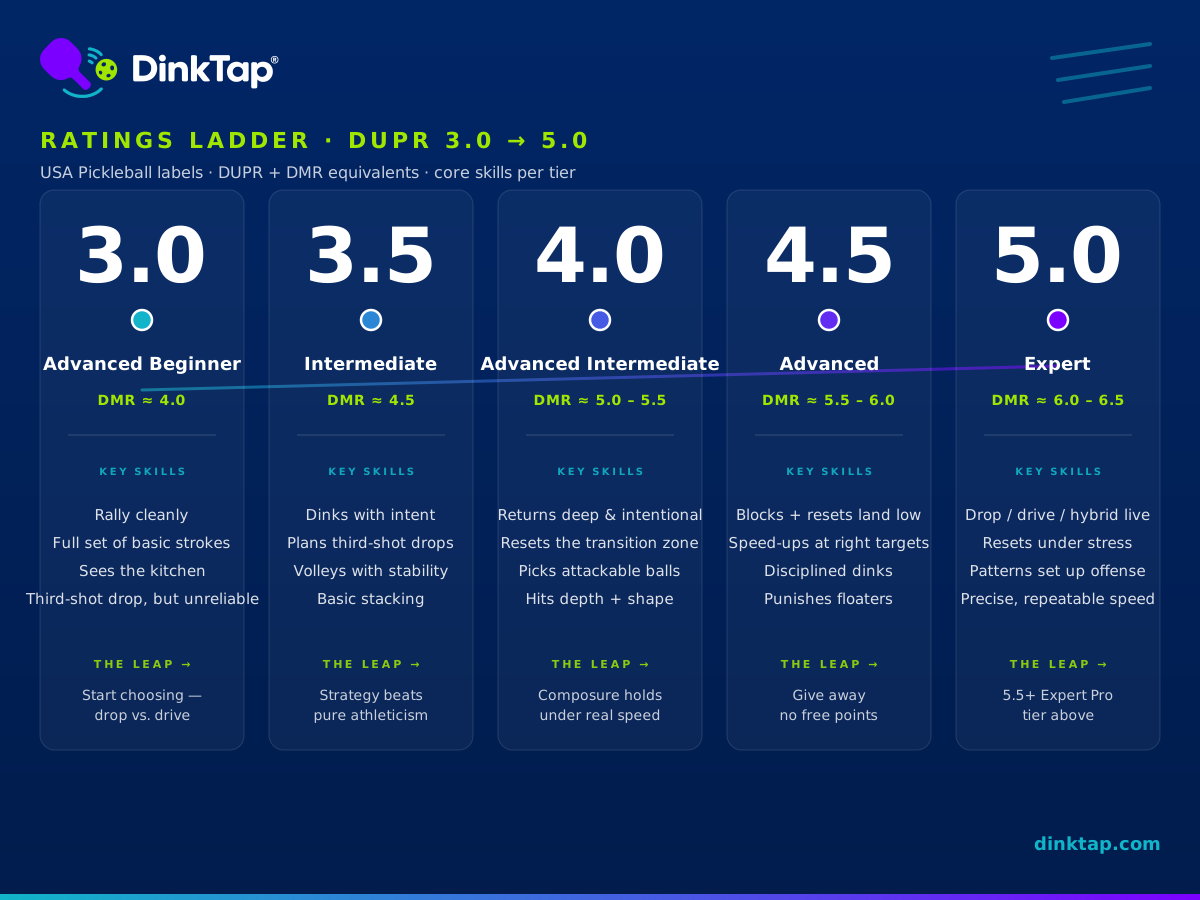
Skill labels follow USA Pickleball’s framework; the numbers are DUPR (2.0–8.0). In DinkTap®, the same milestones map onto DMR (2.0–10.0).
The tiers, broken down
3.0 — Advanced Beginner
At 3.0, the game starts to look like pickleball rather than “paddle-ball.” You can rally, you can hit the full set of basic strokes, and you’re beginning to understand why the non-volley zone (the kitchen) is the most valuable real estate on the court. Standard skill matrices describe 3.0 players as able to hit a medium-paced shot but still lacking consistent directional control and depth, with dinks and third-shot intentions that are developing but unreliable.
What a 3.0 can usually do: keep the ball in play on routine shots, reduce unforced errors, grasp the concept of a third-shot drop (even if it fails often), and compete in recreational games without constant stoppages.
The leap to 3.5: you stop playing every ball the same way. You start choosing — drop vs. drive, dink vs. speed-up, reset vs. counter.
3.5 — Intermediate
3.5 is the largest “serious recreational” bracket in many markets, and the jump from 3.0 to 3.5 is widely considered one of the hardest transitions in the sport. It demands a shift from reactive play to intentional shot selection. This is also where mismatches get exposed fast — players who can’t dink or reset get picked apart.
What a 3.5 can usually do: dink with moderate consistency (though pop-ups still appear), attempt third-shot drops or drives with a plan to get to the kitchen, volley with more stability instead of just reactive punching, and understand basic stacking concepts.
The classic 3.5 plateau: speeding up balls that aren’t actually attackable, winning some games on pure athleticism and then losing to patient, disciplined teams, and reaching the kitchen line but not staying stable once there.
4.0 — Advanced Intermediate
At 4.0, pickleball becomes a strategy sport. You create advantages with depth, shape, and patience rather than just hitting shots, and you begin to neutralize pressure with blocks and resets instead of merely absorbing it. The skill matrices emphasize improved directional control, depth, and decision-making under pressure.
What a 4.0 can usually do: return deeper and more intentionally to limit the opponent’s third-shot options, execute third-shot drops and transition forward with higher success, reset from the transition zone often enough to avoid gifting points, and correctly identify which balls are attackable (leaving the rest alone).
The separator to 4.5: composure improves, the soft game holds up against speed, and counters and resets become purposeful rather than lucky.
4.5 — Advanced
4.5 is where players can win in multiple styles — slower, faster, more aggressive, more patient. The defining ability isn’t just execution; it’s selection and adaptation.
What a 4.5 can usually do: absorb pace with blocks and resets that land low, initiate speed-ups at the right moment and to the correct targets (the hip, the shoulder, the dominant-side patterns), maintain disciplined dinks that don’t drift into the opponent’s strike zone, and punish floating balls consistently without overhitting.
The separator to 5.0: how few free points you give away, and how well you hold structure through chaotic, fast exchanges.
5.0 — Expert
At 5.0, the game is clean. Points end because someone forced an advantage, not because someone donated an error. This is tournament- and open-level pickleball.
What a 5.0 can usually do: keep all three options — third-shot drop, drive, and hybrid — available and select correctly between them, reset even when under genuine stress rather than only when comfortably fed, use dink patterns to set up offense instead of just keeping the ball in play, and deliver speed-ups that are precise and repeatable rather than random.
Above this sits 5.5+ (“Expert Pro”), where descriptive checklists blur into pure competitive results — players who consistently dominate 5.0 fields. You’ll occasionally hear “6.0+” in some clubs, but most standardized public matrices top out at 5.5+; treat “6.0” as an informal label for pro-caliber play unless an organization has defined it explicitly.
Putting it to use
If you’re trying to find your own level, resist the urge to rate yourself by your ceiling. Read the tiers from the bottom up and find the highest one where you can honestly check most boxes under match pressure — not in warm-ups. Stuck between two? That’s normal, and it’s exactly the situation DUPR is built to resolve: log a handful of competitive matches and let the results place you.
The two systems work best together. Use the descriptive levels to understand what to work on — the specific shot or decision that’s holding you at your current tier. Use your DUPR rating to measure whether that work is paying off, and to find balanced games where the pickleball is close, competitive, and fun.
Get DinkTap →
Or see how DMR fits the same skill ladder .
Sources & further reading
- DUPR — How It Works (official): the rating scale, the Reliability Score, the separate singles/doubles ratings, and the four factors behind the calculation.
- DUPR — Pickleball Ratings Explained (official): how match performance, result type, match count, and recency feed the algorithm. (Published March 2025, before the July 2025 “performance-vs-expectation” update — read it alongside How It Works.)
- USA Pickleball — Player Ratings (governing body): names DUPR the official, exclusive rating system for USA Pickleball-owned events, and explains the 2.0–8.0 scale.
- USA Pickleball — Skill Levels & Skill Matrix (governing body): the descriptive 2.0–5.5+ framework and downloadable assessment tools.
- SportsEdTV — Pickleball Skill Levels Explained (2.0 to 5.5+): coach-driven breakdown anchored to the USA Pickleball standard; primary source for the per-tier on-court benchmarks summarized above.
- Pickleball.com — Skill Levels & Ratings Guide: on DUPR’s granularity and the role of the third-shot drop in level progression.
A note on accuracy: skill-level descriptions are inherently qualitative, and different organizations word their matrices slightly differently. The breakdown here reflects the consensus of USA Pickleball’s framework as interpreted by coaching sources; your local club or league may define tiers with minor variations.